Wednesday, December 7, 2016

Amendment 20

"Section 1.The terms of the President and Vice President shall end at noon on the 20th day of January, and the terms of Senators and Representatives at noon on the 3d day of January, of the years in which such terms would have ended if this article had not been ratified; and the terms of their successors shall then begin.

Section 2.The Congress shall assemble at least once in every year, and such meeting shall begin at noon on the 3d day of January, unless they shall by law appoint a different day.

Section 3.If, at the time fixed for the beginning of the term of the President, the President elect shall have died, the Vice President elect shall become President. If a President shall not have been chosen before the time fixed for the beginning of his term, or if the President elect shall have failed to qualify, then the Vice President elect shall act as President until a President shall have qualified; and the Congress may by law provide for the case wherein neither a President elect nor a Vice President elect shall have qualified, declaring who shall then act as President, or the manner in which one who is to act shall be selected, and such person shall act accordingly until a President or Vice President shall have qualified.

Section 4.The Congress may by law provide for the case of the death of any of the persons from whom the House of Representatives may choose a President whenever the right of choice shall have devolved upon them, and for the case of the death of any of the persons from whom the Senate may choose a Vice President whenever the right of choice shall have devolved upon them.

Section 5.Sections 1 and 2 shall take effect on the 15th day of October following the ratification of this article.

Section 6.This article shall be inoperative unless it shall have been ratified as an amendment to the Constitution by the legislatures of three-fourths of the several states within seven years from the date of its submission."


This amendment was brought up because of the time between elections, where the elects could not get anything done until a certain time. In section 2, it states the meeting time of Congress each year, this helps if a new Congress would need to decide a new President. Section 3 states that the VP would take office if something happened to the President-elect. In section 4 states that Congress can state what the secession of the Presidency. That is the majority of the information for this amendment. 


Here is a nice video created by a student (most likely) that explains why we have this amendment and where is came from. 


This comic shows some humor by maybe implying that Obama is a "Lame Duck" President. 

Amendment 19

"The right of citizens of the United States to vote shall not be denied or abridged by the United States or by any state on account of sex.
Congress shall have power to enforce this article by appropriate legislation."

As a woman, I find it interesting that this had to be an amendment in the first place. I guess I shouldn't be surprised considering we enslaved an entire people, so equality was not something on the forefront of their minds. Unfortunately, we do see differences in people everyday because that is how we function as humans. We notice when someone acts different, looks different, and feels different. I am happy that this amendment made its way to the constitution so that we don't have to think about whether or not our daughters or sisters or mothers can vote, and I do believe that things have been getting better each year for gender equality. There are still distinct issues for women that are not present for men, so we have a lot of room to grow, but it is a good thing that we don't have to worry about losing our voice or our momentum. 

I remember watching this School House Rock video as a student in junior high school and knowing that my right to vote would not be taken away from me, and it is because of the great women mentioned in this video that made that possible, even though some of them did not see the day that women got to vote. 


Here is a campaign poster for encouraging men to vote for women's right to vote. It points out three key reasons why women deserve the right to vote: working women, paying taxes, and obeying laws deserve to have a voice when deciding how the country and states will be ran. 

Amendment 18

"Section 1.After one year from the ratification of this article the manufacture, sale, or transportation of intoxicating liquors within, the importation thereof into, or the exportation thereof from the United States and all territory subject to the jurisdiction thereof for beverage purposes is hereby prohibited.

Section 2.The Congress and the several states shall have concurrent power to enforce this article by appropriate legislation.

Section 3.This article shall be inoperative unless it shall have been ratified as an amendment to the Constitution by the legislatures of the several states, as provided in the Constitution, within seven years from the date of the submission hereof to the states by the Congress."

This amendment is where the prohibition era began, creating some of the craziest party years of the U. S. There were more people drinking during prohibition than there were before. It is just like when your parents tell you not to do something when you were younger and yet you do it because they told you you can't. I think whomever passed this amendment meant well, but law enforcement was costing the U. S. more than it had ever before, and so it was later repealed to create peace among the government and the people. 


This video quickly explains the prohibition era and why it was overturned. Franklin Roosevelt campaigned against prohibition, creating his path to the White House. I can only imagine what Europe was thinking when this was going on in the U. S...


This comic covers the Prohibition because the "wet trough" is representing the "wet" vs "dry" people in the U. S. This means that people who drink are wet, people who don't are dry. 


Amendment 17

"The Senate of the United States shall be composed of two Senators from each state, elected by the people thereof, for six years; and each Senator shall have one vote. The electors in each state shall have the qualifications requisite for electors of the most numerous branch of the state legislatures.
When vacancies happen in the representation of any state in the Senate, the executive authority of such state shall issue writs of election to fill such vacancies: Provided, that the legislature of any state may empower the executive thereof to make temporary appointments until the people fill the vacancies by election as the legislature may direct.
This amendment shall not be so construed as to affect the election or term of any Senator chosen before it becomes valid as part of the Constitution."

The 17th amendment creates the direct democracy of the senate, having the people of each state vote for the state legislature. The vacancies that happen in the senate will be determined by the executive authority of each state. Some people want to repeal this amendment in a way that would give more power to the states rather than the federal government. 


Here is a video of a tea party candidate explaining his reasoning behind repealing the 17th amendment. I don't think he does a very good job at explaining why he wants it repealed, he does say that he doesn't think it will ever happen. 


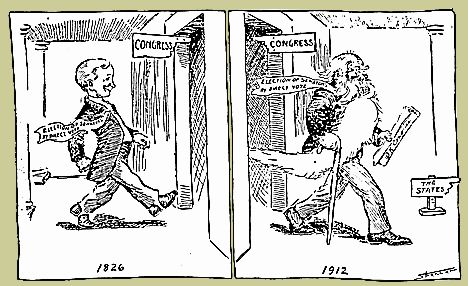
This comic represents the long terms that senators have in congress. I think the artist is trying to explain that the senators don't progress like the country does, so it is a dangerous game in the senate. 


Amendment 16

"The Congress shall have power to lay and collect taxes on incomes, from whatever source derived, without apportionment among the several states, and without regard to any census or enumeration." 

In the 16th amendment, the Federal government gains the power to tax income. This way, they would be able to keep the taxes they collected for the use of the Federal government versus sharing the money with the states. I think it was a smart move for them to generate some sort of revenue so that they could build roads and maintain things all over the U. S. 


In this episode of the constitution for dummies series, Hughes talks about the taxes that the government implemented and why they needed taxes. Pollock v Farmers' Load and Trust covers the argument about a direct tax versus an income tax. This means that direct tax must be apportioned by the census, income other than labor cannot be taxed. 


In this comic, it jokes about how the American people must pay income tax each year. In reality this is probably something I would do and joke about. 

Amendment 15

Section 1.The right of citizens of the United States to vote shall not be denied or abridged by the United States or by any state on account of race, color, or previous condition of servitude.


Section 2.The Congress shall have power to enforce this article by appropriate legislation.

Section 1 of amendment 15 gives all males (black and white) the right to vote. One of the most interesting things about this is, while they didn't even consider black people to count as one whole person at one point, they didn't even think that rights for women would be an important add in at this moment? Now, I'm not trying to be bitter, and if I am coming off that way I apologize, but thinking that women shouldn't have to think about politics, or are not smart enough to is still offensive today. I am blessed that I live in a country at a time when all my rights were already fought for, but keeping it known that this was not so long ago, will keep us fighting for the rights they have already promised us. Section 2 simply states that congress has the power to enforce this law. 


This quick video has some interesting facts about what was happening in the South with black men who were not only voting but they were also elected to office. 


This image portrays an interesting view. Most white people are ignorant of what African Americans had to go through, and they just don't think about it. The other interesting thing is that women had to wait even longer... 

Amendment 14


"Section 1.All persons born or naturalized in the United States, and subject to the jurisdiction thereof, are citizens of the United States and of the state wherein they reside. No state shall make or enforce any law which shall abridge the privileges or immunities of citizens of the United States; nor shall any state deprive any person of life, liberty, or property, without due process of law; nor deny to any person within its jurisdiction the equal protection of the laws.

Section 2.Representatives shall be apportioned among the several states according to their respective numbers, counting the whole number of persons in each state, excluding Indians not taxed. But when the right to vote at any election for the choice of electors for President and Vice President of the United States, Representatives in Congress, the executive and judicial officers of a state, or the members of the legislature thereof, is denied to any of the male inhabitants of such state, being twenty-one years of age, and citizens of the United States, or in any way abridged, except for participation in rebellion, or other crime, the basis of representation therein shall be reduced in the proportion which the number of such male citizens shall bear to the whole number of male citizens twenty-one years of age in such state.

Section 3.No person shall be a Senator or Representative in Congress, or elector of President and Vice President, or hold any office, civil or military, under the United States, or under any state, who, having previously taken an oath, as a member of Congress, or as an officer of the United States, or as a member of any state legislature, or as an executive or judicial officer of any state, to support the Constitution of the United States, shall have engaged in insurrection or rebellion against the same, or given aid or comfort to the enemies thereof. But Congress may by a vote of two-thirds of each House, remove such disability.

Section 4.The validity of the public debt of the United States, authorized by law, including debts incurred for payment of pensions and bounties for services in suppressing insurrection or rebellion, shall not be questioned. But neither the United States nor any state shall assume or pay any debt or obligation incurred in aid of insurrection or rebellion against the United States, or any claim for the loss or emancipation of any slave; but all such debts, obligations and claims shall be held illegal and void.

Section 5.The Congress shall have power to enforce, by appropriate legislation, the provisions of this article."


Section 1 of amendment 14 gives citizenship to all people who are born or naturalized in the U. S. This helped with African American people who were born into slavery or people who had immigrated to this country and had children, etc. This section keeps the states from creating any laws that would affect a citizens' rights, or take the right of due process of law away from them. This section is very important especially because of the civil war. The next section of the 14th amendment corrects the 3/5th's compromise and makes sure that all citizens, except Native Americans, will be counted for the total population. In section 3 of amendment 14, it prohibits people who had been involved with the rebellion from being a Senator, Representative, or President/VP. This is important because it will prevent the government from another potential civil war if they do not have those supporters in office. Section 4 states that the government simply won't pay for any debt incurred during the civil war if it was for the rebellion.. which makes sense. And in section 5, Congress is stating that they have the power to enforce the previous 4 sections.


Hughes does a great job of explaining the key points of this amendment, noting that all people are automatic citizens if they are born in the U. S. and also providing facts on cases like Plessy v Ferguson and Brown v Board of Education.


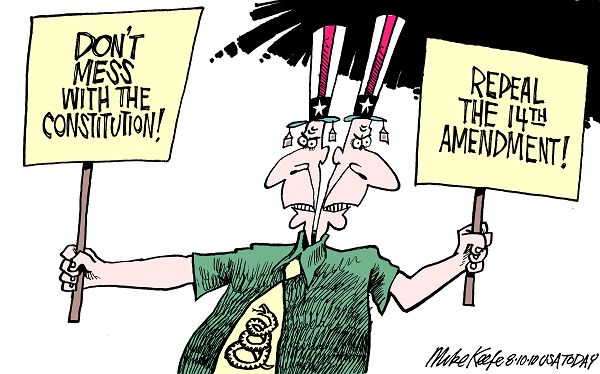
Here is an image that I found interesting in my research. On the left you see a sign saying: Don't mess with the constitution! On the right you see a sign saying: Repeal the 14th amendment! And in the middle you see a person or "siamese twin" rather, in the middle holding the two signs. In my opinion, the point the artist is trying to make is that people are hypocrites, especially when it comes to politics. It's interesting because the world makes it difficult not to be hypocritical, but this is a really great, and funny, example of people who either do exist or have existed in our country. I can tell you right now, I don't associate with them. 

Tuesday, December 6, 2016

Amendment 13

Section 1.Neither slavery nor involuntary servitude, except as a punishment for crime whereof the party shall have been duly convicted, shall exist within the United States, or any place subject to their jurisdiction.
Section 2.Congress shall have power to enforce this article by appropriate legislation.


This is the first of the Reconstruction and civil rights amendments. To some surprise slavery is no where legalized in the constitution. Some ratified this amendment not on the grounds of making everyone equal, but just so that the civil war would end. Lincoln wanted to get this amendment ratified so that there would be no chance of slavery to return after the civil war was over. This amendment abolished slavery, erasing the need for the emancipation proclamation. 


This amendment was very important to President Lincoln because he believed that there was a possibility that slavery would return even after the civil war ended. The 13th amendment abolished slavery in the U. S.


If you don't see this on every blog you read this week, I will be disappointed. Everything in this video grabs your attention and makes me want to watch the rest of the movie. It really is hard to believe that people were able to treat others like they did during these times, but luckily, because of leaders like Lincoln, times have changed and are still changing today. 


Amendment 12

"The electors shall meet in their respective states and vote by ballot for President and Vice-President, one of whom, at least, shall not be an inhabitant of the same state with themselves; they shall name in their ballots the person voted for as President, and in distinct ballots the person voted for as Vice-President, and they shall make distinct lists of all persons voted for as President, and of all persons voted for as Vice-President, and of the number of votes for each, which lists they shall sign and certify, and transmit sealed to the seat of the government of the United States, directed to the President of the Senate;--The President of the Senate shall, in the presence of the Senate and House of Representatives, open all the certificates and the votes shall then be counted;--the person having the greatest number of votes for President, shall be the President, if such number be a majority of the whole number of electors appointed; and if no person have such majority, then from the persons having the highest numbers not exceeding three on the list of those voted for as President, the House of Representatives shall choose immediately, by ballot, the President. But in choosing the President, the votes shall be taken by states, the representation from each state having one vote; a quorum for this purpose shall consist of a member or members from two-thirds of the states, and a majority of all the states shall be necessary to a choice. And if the House of Representatives shall not choose a President whenever the right of choice shall devolve upon them, before the fourth day of March next following, then the Vice-President shall act as President, as in the case of the death or other constitutional disability of the President. The person having the greatest number of votes as Vice-President, shall be the Vice-President, if such number be a majority of the whole number of electors appointed, and if no person have a majority, then from the two highest numbers on the list, the Senate shall choose the Vice-President; a quorum for the purpose shall consist of two-thirds of the whole number of Senators, and a majority of the whole number shall be necessary to a choice. But no person constitutionally ineligible to the office of President shall be eligible to that of Vice-President of the United States."


According to the 12th amendment, we established a process of electing a President and Vice President. Representatives from each state choose a President and a Vice President on their ballot, as stated above. This is because of the confusion of the election in 1796, two candidates from different parties were elected President and VP. The importance of this process helped to make a more unified White House. 


Here is a video someone probably should have shared with the democratic party this past year... My favorite quote says, "...the system (electoral college) encourages coalition-building and national campaigning, in order to win a candidate must have the support of many different types of voters, from all different parts of the country." I don't think Secretary Clinton realized what kind of ground President- elect Trump was covering on his campaign. It's safe to say that I was not completely sold on either candidate this year, but Trump obviously had the better plan, at least for his path to the White House.

Here is an interesting comic, almost a continuation of the above paragraph. Each presidential candidate must have a good plan when running for president, because without one they will find that it is much harder than it looks. 

Amendment 11

"The judicial power of the United States shall not be construed to extend to any suit in law or equity, commenced or prosecuted against one of the United States by citizens of another state, or by citizens or subjects of any foreign state."


In amendment 11, it is limiting the amount of power that the judicial branch has overall. This is helpful because of checks and balances, making sure that each branch of government does not get too powerful. 

This video explains how they came about this amendment, dating back to the "days of Yore" where they got the term sovereign immunity. This amendment states that the courts cannot hear cases where people are suing the government, only if a government worker does something unconstitutional, which they will be stripped of their rights as a government worker and losing their sovereign immunity. 


Okay, I'm almost positive some 7 year old girl named Rachael filled in the blanks for this comic and I honestly think it's hilarious and explains the amendment to the simplest degree, but still gets the point across. It reminds me of a "Kid Letters" sketch from Jimmy Fallon. Here, I'll post it so you can get a good laugh in: