Tuesday, December 6, 2016

Amendment 10

"The powers not delegated to the United States by the Constitution, nor prohibited by it to the states, are reserved to the states respectively, or to the people."


This amendment is something that is important to me because not everyone understands the importance of local government. Anything not stated in the U. S. Constitution is up to the states to decide. So, legalization of gay marriage, legalization of marijuana, even education can all begin at the local level. That’s why it is so important for people to vote during local elections so that they are able to influence the community around them. 


This image shows the importance of getting involved in state and local government. The laws and regulations passed at the state level will affect people more quickly than they understand. The rules for the Federal government are much more difficult to add to or remove, for that matter.


This amendment is the final amendment in the "Bill of Rights", it was made so that the Federal government would not step outside the boundaries of the constitution. This is a "truism", meaning it doesn't make a law, it just states that the federal government has power over some things, but not everything. The following link will take you to a video that explains the 10th amendment in more detail.

http://study.com/academy/lesson/the-10th-amendment-definition-summary-examples.html


Amendment 9

"The enumeration in the Constitution, of certain rights, shall not be construed to deny or disparage others retained by the people."


This amendment covers the reservation of rights of people, meaning that any rights not stated in the Bill of Rights can still be considered a right, even though it isn’t written down. This is so that we are not limiting our liberty. For example, there can be a guaranteed right of privacy, it can’t be denied even though it isn’t written down. 


This video does a great job of explaining the right of privacy, referencing three other amendments dealing with privacy. Whom ever made the video obviously doesn't have much experience, but the kids do a good job at the beginning of the video. 

This image explains how the 9th amendment shows that our liberty is not limited. This is important because when they wrote this, they knew that the country would change and advance beyond their imagination, so they put it in writing that citizens can be entitled to more rights than what is listed in the bill of rights. 


Amendment 8

Excessive bail shall not be required, nor excessive fines imposed, nor cruel and unusual punishments inflicted.


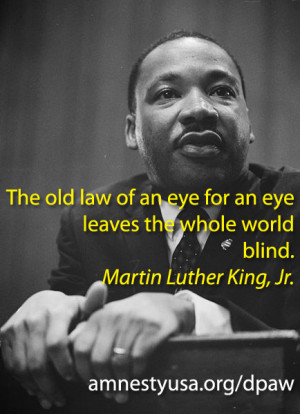
The hardest part about this amendment is that from each culture, there is a different definition of what “cruel and unusual punishment” is among different people. The death penalty has caused much controversy over the years, supporters saying it is “an eye for an eye”. In reality, this punishment has not caused crimes to diminish. I think there would be a better impact in our nation if we used the money we would have used to fund the death penalty (in some states) on education, investing in their futures, insuring that they know how to be good people, and helping to make them happy as they grow up. I also believe that it is not any one person’s decision but God’s to say if they live or die. 


This video gives great examples for the pros and cons of the death penalty. I will warn, this video is a little bit strange because of the verbiage they use. 


This quote from Dr. Martin Luther King, Jr. gives us a great perspective on the death penalty. Again, how can we be the ones who decides who lives and dies? Does that not make us just like the murders who we put to death? I cannot imagine the pain of losing someone this way, but we must overcome the hate and respond with love, just like MLK did throughout his career. 

Amendment 7

"In suits at common law, where the value in controversy shall exceed twenty dollars, the right of trial by jury shall be preserved, and no fact tried by a jury, shall be otherwise reexamined in any court of the United States, than according to the rules of the common law."


In today’s age, all civil trials any must be worth more than $75,000, which is a big jump from the $20 they originally considered. This change is important because the government can spend much less time over smaller cases, not only saving time, but money as well. Civil trials are important, but there is a bigger concern with criminal cases. 


This amendment was harder to find media posts than any other. IF it's not a criminal trial, you have the right to civil law suit, requiring at least 6 jurors, and must be a unanimous decision. The supreme court has the right to review appellate decisions based on facts. 

This image is a joke about how cheap it was a while ago for civil cases. 


Amendment 6

"In all criminal prosecutions, the accused shall enjoy the right to a speedy and public trial, by an impartial jury of the state and district wherein the crime shall have been committed, which district shall have been previously ascertained by law, and to be informed of the nature and cause of the accusation; to be confronted with the witnesses against him; to have compulsory process for obtaining witnesses in his favor, and to have the assistance of counsel for his defense."


As stated in previous amendments, accused peoples will have the right to a public trial (not necessarily speedy). There is a huge importance when picking an impartial jury; that way the jury will not be biased when listening to all aspects of the trial. This amendment also promises “the assistance of counsel” which enables the defendant to have a lawyer present when being questioned and also to have a lawyer for the trial.  

In this video, HIPHUGHES explains a speedy trail can be violated after about a year; this is a right to the citizens accused, so that the trial is on a fair time frame. The impartial jury is very important so that the jury is not biased, there is a process to weed out people who may be jurors so that there is no one that will be impartial to the defendant. The next part of the amendment covers the clarity of the accusation. The confrontation clause means that whoever is accusing them of a crime must confront them. There are certain exceptions with the confrontation clause; i.e. evidence can be "confrontation". The ability to name witnesses to the stand requires those called to the stand to go to the stand, and be confronted and questions. The last part of the amendment gives people lawyers even if they cannot afford it. I really enjoy how this guy does these videos because of all the facts he provides, and he does a really nice job of explaining what everything means in ways that all ages can understand. 


Here is a funny way at looking at the "speedy trial" part of the 6th amendment. This is not what they meant by a speedy trial, of course. They simply mean that if the court system has not made any progress in about a years time with the case, the 6th amendment is violated. 


Amendment 5

"No person shall be held to answer for a capital, or otherwise infamous crime, unless on a presentment or indictment of a grand jury, except in cases arising in the land or naval forces, or in the militia, when in actual service in time of war or public danger; nor shall any person be subject for the same offense to be twice put in jeopardy of life or limb; nor shall be compelled in any criminal case to be a witness against himself, nor be deprived of life, liberty, or property, without due process of law; nor shall private property be taken for public use, without just compensation."


This amendment has a lot of words in it, and I get it. There are many important things to consider when someone is on trial. The first part explains that no one will be punished for a crime unless they are given a a fair trail; this is important because then people will be able to defend themselves if they are innocent, vs being accused and put in prison. 
As the run on sentence of an amendment continues, it states that no one will be punished for the same crime twice, unless of course they commit the crime twice. This is has created some controversy, because of mistrials, meaning that someone was not given the correct amount of punishment and people think they deserve a worse sentence. Unfortunately and fortunately, once someone serves their sentence, they cannot be tried for that crime again. 
As people have seen, there are many times where people “Plead the 5th”. This amendment implies that no one will be a witness against themselves meaning that there should be no questions to the defendant that will cause them to prove that they are guilty. This tends to be confusing and over-used by defendants, in my opinion because when put on trial, people have to be honest in court, and pleading the 5th does not make you exempt from answering a judge. 
The next part of amendment 5 explains that no one will be convicted without “due process of law” which means that they will have a fair trial before being deemed guilty for a crime. This is very important so that a person is able to defend themselves if they are innocent.

At the end, it states that “private property will not be taken for public use without just compensation”; unfortunately that doesn’t mean market price, the government will give whatever amount they deem worthy for property that will be used for public use. 

Can you believe there are actually people in the world who go through their lives without hearts and now respect for other human beings? Well if you don't, here is proof. Martin Shkreli had a hearing with congress earlier this year for his unexplainably insane increase in price for a life saving drug. He is seen in this video "pleading the 5th" so that he does not incriminate himself, when in reality, there were little to no questions that could even be considered self-incriminating. As you can see, congress has enough and ejects him from the house floor. 


This is a funny comic that implies that the boy tried to plead the 5th while taking his spelling test, which obviously wouldn't apply. The term take the 5th amendment means that someone is invoking the rights that are given to them in the 5th. 


Amendment 4

"The right of the people to be secure in their persons, houses, papers, and effects, against unreasonable searches and seizures, shall not be violated, and no warrants shall issue, but upon probable cause, supported by oath or affirmation, and particularly describing the place to be searched, and the persons or things to be seized."


This amendment is definitely one of the most important because it protects people from the government, and that’s exactly why we have a constitution to make sure the government doesn’t have too much power. Amendment 4 is key when people are being accused of crimes they may or may not have committed. Police cannot come into your home or arrest you (at random) without a warrant from a judge, stating what they are being accused of. If we didn’t have this amendment, there would be even more innocent people in jail and prison today. 

This video does a great job of not only explaining the 4th amendment, but also discusses the exclusionary rule. The exclusionary rule was put into place so that if police did not obey the 4th amendment, any evidence found without a warrant in a home or person they searched, cannot be used against that person. This keeps police in check, requiring them to get a warrant, unfortunately it can also keep guilty people out of prison. 


This comic is a good example of why there is an exclusionary rule. The hard side of the exclusionary rule is that even if evidence is found and the jury knows about the evidence, it will be hard for them to "forget" about it and not let that influence their decision. 


Amendment 3

"No soldier shall, in time of peace be quartered in any house, without the consent of the owner, nor in time of war, but in a manner to be prescribed by law."


I’m under the impression that this was a problem for the people who used to live under the rules of the British government, and maybe they were forced to house the militia at a moments notice, it obviously isn’t a problem today. I think it’s interesting that this is an amendment when we have much bigger problems on our hands. 


No quartering of soldiers, is probably the least enforced because it is really only relevant during the the late 1700's. This has mostly just been followed because is was made a law, and has only been mentioned once referencing privacy in your own home. 

This comic is jokingly stating the 3rd amendment, since this one isn't necessarily a huge concern in today's age, this is just a good image to help remember what the amendment is about.  

Amendment 2

"A well regulated militia, being necessary to the security of a free state, the right of the people to keep and bear arms, shall not be infringed."

The first half of this amendment was more relevant when we didn’t have the strongest military in the world. The back half has caused more controversy in today’s age than most amendments, at least here in the midwest. What is interesting is that it seems like half of U. S. citizens believe that having more strict gun laws will help decrease the potential for mass shootings, the other half believe that the government wants to take away their guns and they will then have no way to protect themselves. Although both are semi-valid points, I don’t think that the government will do anything too extreme, besides the fact that they need to do background checks on people who want to purchase guns. 


This video does a great job of explaining the 2nd amendment and what it meant when it was written. Now this is a more conservative view, but there is a bit of humor as they explain it so it is not an overbearing view, I just think it is explained well. He says that the right to keep and bear arms is a right for THE PEOPLE, not the militia, and this right cannot be taken away from the people by the militia. This is so that the militia does not have too much power over the people. 


Now this is a great example of why more strict gun laws, or at the minimum, background checks should be implemented for anyone trying to purchase weapons. The scary thing is that gun laws have not changed, even though our country has more mass shootings than any country in the world; that can be due to our large population size and also the fact that we have more armed citizens than any country in the world. 

Amendment 1

"Congress shall make no law respecting an establishment of religion, or prohibiting the free exercise thereof; or abridging the freedom of speech, or of the press; or the right of the people peaceably to assemble, and to petition the government for a redress of grievances."


Amendment 1 was one of the most important to the people who came to this land because they had no freedom to practice the beliefs they held. This amendment is a key element in proving people they are wrong for judging someone for their beliefs or why someone would protest something. It all comes back to the fact that no one would want to be told they couldn’t believe a certain way, so we are in no place to tell anyone else what they shouldn’t believe in their morals. It also covers the freedom of speech or press, which means that people can say or print what they want about the government without consequences. Amendment 1 gives the people the right to assemble peacefully, meaning citizens can gather to talk about the government and make groups however they please, so long as it is peaceful. The right to petition the government means that people can send their concerns to the government so that the leaders of their state and country can know what the people want. 


Okay, this guy is a bit of a cheese-ball, but he does a great job of explaining all five points of the 1st amendment. I like that he references all kinds of worship venues when addressing freedom of religion. He also points out that the government cannot make laws that prevents us from talking about our government. When he explains freedom of the press, he says that the government has no power when it comes to news sources. This amendment allows people to gather to share ideas, as the right to peacefully assemble; people are able to be for or against the government. As he explains the right to petition, he says that if we have grievances, we can send them to our government and make our concerns known, explaining what we like and what we don't like. 


This cartoon is a little comedy relief. I don't think it's offensive to women, but since the majority of women talk a lot, this is jokingly saying that maybe they don't want to tell their wives that there is now freedom of speech.